
The Daimon
On living with what I cannot tame

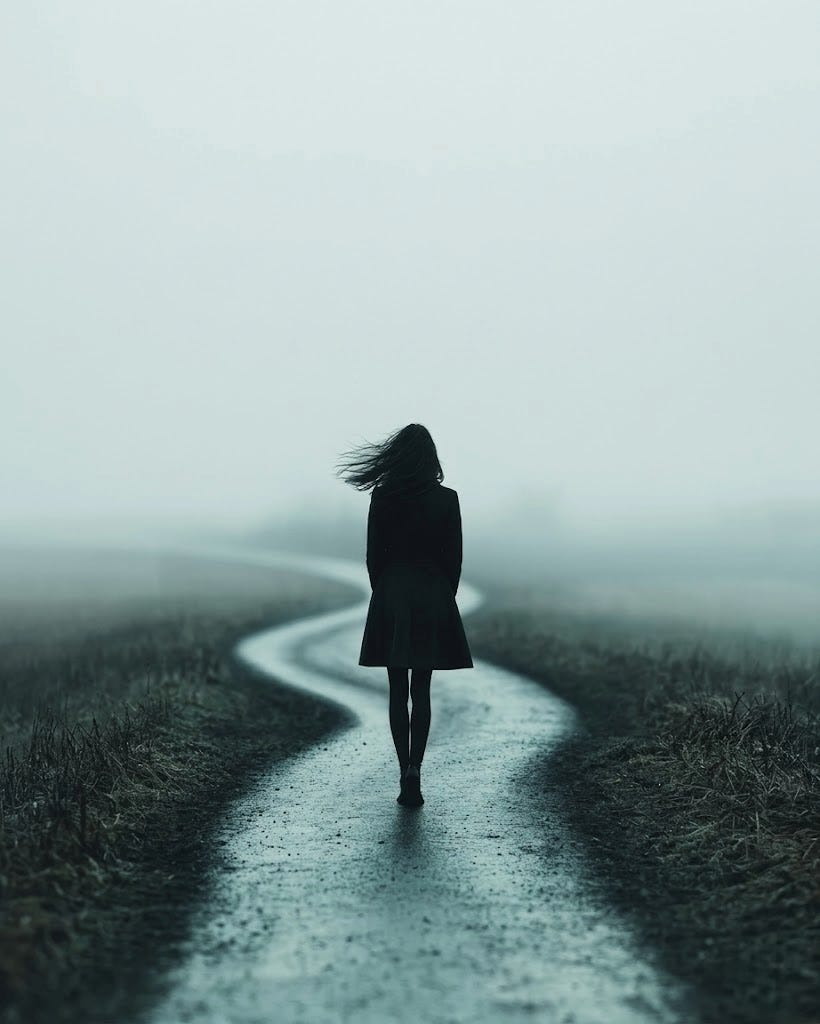
There is a certain kind of armour I have fashioned, in the quiet hours, against the world. Not the fabulous glinting bronze of Achilles, rather something more like the chain-mail of a medieval foot-soldier — improvised, made to be hidden, designed less to declare than to absorb. I’ve acquired it piece by piece. A look at the wrong moment; a pronoun delivered with the curl of the lip; the recoil of a stranger: each contributes its rivet. Eventually, I’m enclosed without quite having noticed the assembly.
I write as someone who has built such an armour and who has, simultaneously and with no contradiction whatever, learned to live with what is inside it. I suspect we all carry a passenger, I certainly do. The Greeks had a word for it — daimon — and meant by it something closer to a presiding spirit than to the screeching imp of later religious invention. Socrates spoke of his daimonion as a kind of internal advisor, a voice telling him principally when not to act. The daimon I have in mind is something less Socratic and more squalid. It is a demon in the more vulgar sense: the resident shame, the heir of every cruelty inflicted and every cruelty anticipated, crouched in some recess of my mind, waiting.
The fashionable thing to say, I imagine, in the literature one is now expected to consult, is that the demon can be tamed. The Internet and bookshops are overrun with self-help literature. You negotiate with it, make peace, learn its name, integrate the shadow, and so proceed into the broad uplands of well-adjusted selfhood. I do not doubt that this is true for some. I am glad for them, glad that they have escaped what I have not. I cannot pretend, even for the politest of reasons, that I am among them. My demon is uncaged occasionally (perhaps it is never quite caged?). The bars hold for days or weeks or months, they hold well, and then some small thing — a glance, an overheard word, a slip of the tongue — and the lock slips, and out it comes, hungry as ever.
I am labelled a transgender woman, which is to say I have made the singular and laborious and, in moments, sublime passage from one side of an arbitrary gender line to another. I should also add that I am not proud of this. The journey shames me, in ways I have not entirely worked out; perhaps the shame is the residue of all the years before, when shame was simply the air one breathed; perhaps it is something more specific to me. I cannot quite muster the enthusiasm which is now demanded of the cohort to which I am assigned. I have no flag. I do not march. I am generally not, in the cant of the present, an advocate or an ally or an activist, and I propose to remain stubbornly none of these things. What I want, with a fierceness that occasionally surprises me, is to be left alone: to walk to the shops, to pay for my coffee, to exchange a few words, and to walk home again without anyone having taken the slightest interest in the matter. Unnoticed. The most modest of ambitions, and, as I have discovered, difficult to secure.
For there is the small matter of the body. The male-to-female transition (I prefer correction) is, I will hazard, a feat — and I use the word in something like its old chivalric sense, a labour requiring not merely will but a kind of consenting violence against one’s own architecture. Years of testosterone have done their patient work upon my skeleton, my larynx, my hands; the work cannot be wholly undone. Hormones rearrange what they can; surgeons amend what they are paid for; one trains the voice (poorly, in my case), the gait, the gestures, until the new self is neither a performance nor quite a reflex but something in between — lived in, broken in, like a good boot. And it is remarkable what can be achieved. On my better days, I have walked through a crowd as anonymous as anyone in it, and felt the simple pleasure of unremarked passage which most of humanity enjoys without ever knowing it has a name.
But I know the clues remain. They are subtler than I would like … a vowel, perhaps, that fails to land where it should; a wrist that catches the light at an angle; the small involuntary tells which decades of my biology imprint upon me. Someone — and there is always someone — picks them up. Sometimes the recognition is benign and silent; I suspect it without confirmation; I walk on. Other times, it is not benign at all, and one is suddenly, in the middle of a perfectly ordinary errand, the object of a stranger’s amusement or pity or contempt. The world, which a moment ago contained groceries and weather and trivial decisions, contains now only the gaze; and the whole hard-won architecture crumples like a paper lantern in the rain.
Today, to take the most local of examples, it has happened twice. The first instance was a colleague who used, in the middle of an otherwise dull meeting, the deadname: the name I once answered to and no longer do. It hung there in the air like a small dead thing left on the mat. An accident, I hope — a slip of muscle memory, meaning nothing. The second was in the street, when a man I had never seen before and shall never see again addressed me with the wrong honorific. Both incidents, on the page, are trivial. I could not get up a campaign about them. They would not justify a paragraph in a more respectable story than this one. And yet they are precisely the keys the demon waits for: small, common, deniable. The grand insults I can armour against; it is the casual ones, falling like rain, that find the gap in the mail.
This is when the demon, which I had thought caged for some considerable stretch, comes out to feed. It does not feed politely. It gorges. It tells me, in the voice I know best because it is fashioned of my own, that the armour was always a fraud and the disguise always too thin; that I’m a curiosity and was always going to be; that the project of becoming myself is an absurdity nursed in private rooms and exploded in public ones. And it is no use answering, because the demon has answered in advance. It has all the best arguments. It has been preparing them for decades.
Humiliation is a word you know from books before you know it from life, and the books rather mis-describe it. It is not a feeling, exactly; for me, it is a temperature. The face goes hot; the hands go cold; the inside of my chest contracts as though some essential organ were preparing to flee through the throat. The animal in me wants, very simply, to run — to leave the street, the room, the country, the body itself, and never again to be seen by anyone for any reason whatever. You have, in such moments, a brief and almost interesting glimpse of why people disappear: not from cunning but from instinct, the same instinct that sends a wounded fox into the hedge. The shame, denied its exit, travels inward instead and goes looking for somewhere dark to settle.
It settles, in my case, in the small hours. It is then that the demon, replete from its earlier meal, sits down to its second course: the long catalogue of grievances ancient and modern, the reel of every previous humiliation cued up and rolling, the cool, quiet voice that suggests, with the air of a friend offering reasonable counsel, that there exist permanent solutions to temporary problems. I will not dignify the suggestion with elaboration. I will say only that you learn, with practice, to let that particular voice speak without taking dictation. It is a skill not unlike outwaiting a tantrum in a small child: one does not engage; one does not argue; one simply allows the thing to run its course, knowing it must end, even on the nights when it does not feel as though it ever will.
The thing I cannot quite credit, while it is happening, is the demon’s perfect indifference to the evidence. I am, by any sane reckoning, a woman with a great deal to be going on with. I have children whom I adore, a fact more steadying than any I know. I have, somewhat to my own astonishment, the love of an extraordinary woman, who chose me with her eyes open and chooses me still. And then there’s the company of horses, a view of the hills in certain weathers that I would not exchange for the contents of a national gallery. None of this — and this is the part that beggars rational description — none of this counts for anything when the demon is in spate. It is not that the good things are forgotten; they are remembered with perfect clarity and remain, somehow, inaccessible, like a glass of water on the far side of a locked door. I see them; I cannot reach them; the demon’s rage rolls over them like a tide over a beach, and they vanish beneath it as though they had never been. The demon does not respond to the argument. It does not respond to evidence. It cannot be reasoned out of a position one did not reason it into. From the outside, this must look like ingratitude of the most florid sort. From the inside, it is something quite different: not the refusal to feel grateful but the temporary inability to feel anything at all, save the cold rolling weight of the demon’s contempt.
I will not insult you by pretending there is a silver bullet for this. There is not that I know of. Anyone who tells you otherwise is selling crap — a book, a faith, a course of treatment, a movement. I have learned to distrust, with the distrust one reserves for those who would patronise one in the name of solidarity, all schemes of total liberation. The work is daily. It is to be done again on Monday, and again on Tuesday, and again the Tuesday after that, until one is too old or too tired to do it, at which point I expect I simply give in and let the demon have the last word. I do not yet know how that conversation goes.
What can be said in mitigation is that the highs are real, and they are spectacular. I mean by this the days, the hours, the whole long stretches in which I am simply the person I have always quietly known myself to be, walking through the ordinary world, doing ordinary things, with the demon dozing somewhere out of sight. The release is so complete as to be physical: a lightness in the limbs, an opening in the chest, the discovery that breath is something I have, in fact, all this time been holding. I cannot recommend this road to anyone, because the price is monstrous and the journey is private, and not everyone who sets out arrives. But I will say, for the public record, that having lived through both, I would not exchange the worst of the lows for a single hour of what came before. The lows are devastating; the highs are a kind of grace; and somewhere between them, in the long flat middle, I walk unnoticed down a street in the early evening, and am — briefly — free.
Georgie Bear. x